Skip to content
watchingthat
Watching That / Customers / NY Post
Case Study · Digital Publisher Client

Programmatic visibility that stopped depending on the reps.

NY Post’s revenue-operations team needed to find, fix, and solve revenue-impacting issues across their video advertising in real time — across GAM, eight SSPs, and partner deals. They run Watching That for diagnostics, troubleshooting, and reporting — and protect 2M+ daily impressions.

2M+ daily impressions protected
“Watching That has given us full control of our video advertising…their diagnostics and troubleshooting tools have helped us find, fix and solve revenue impacting issues much more quickly and easily than before. And their rich business grade reporting means everyone is always in the know about where we are, what needs to be done and how to go about it.”
— Amanda Gomez, VP Revenue Operations, New York Post
TL;DR · the number

What Inspect, Analysis, and Report returned to the Post’s revenue-operations team.

Window · 2024
Protected
2M+daily
Diagnostics, troubleshooting, and reporting across GAM and eight SSPs, drawing on a single live data layer. Revenue-impacting issues found and solved faster than reconciliation-cycle visibility allowed.
Cross-checked against GAM & SSP logs
Stack surfaces
GAM · SSP · header bidding
Coverage
Display · Video · PMP
The situation

Three partner realities, none of them the truth.

Before programmatic-first publishers stand up an independent reconciliation, every programmatic conversation starts with a disagreement about the numbers. The team spends its judgement on reconciling — not on deciding what to do about what the numbers meant.

Beat · 01

Eight SSPs. Five dashboards. One source of truth, missing.

Each supply partner reports against its own definition of a served impression. GAM reports against its own. Reconciling them takes a weekly spreadsheet pull, a call with each rep, and an apologetic note to finance about which number to trust.

Beat · 02

Fill rate drifts — and drifts quietly.

On programmatic-first publishers managing video + display supply, partner-level fill rate can degrade for a fortnight before anyone notices, because the dashboard that rolls everything up averages the loss into invisibility. By the time it shows, the PMP renewal is already in motion.

Beat · 03

Discrepancy is a negotiation, not a fact.

When the monthly variance lands, each SSP’s rep has a different story. Without an independent log of what the page actually rendered, the publisher’s team is negotiating against five narratives with no evidence of its own.

Illustrative timeline

What one caught discrepancy looks like, beat by beat.

Illustrative timeline. The first month a reconciliation is live across all eight SSPs, one partner’s reported impressions can diverge sharply from the independent log. The beats below show what the audit looks like next.

Monitor · ssp-vs-gam-discrepancy
window · 24h
Mon 07 · 10:00
Monthly reconciliation opens — seven SSPs within 1.5% of GAM.
Independent impression count, sampled against the Post’s own page-render log. Seven partners inside tolerance. One partner showing +17.3% against GAM on video inventory.
Mon 07 · 10:04
Drill-down surfaces the surface.
Discrepancy isolated to one tag group on video pre-roll. Not the whole partner, not the whole day — a named inventory surface with a time window.
Mon 07 · 10:22
Anomaly — partner tag firing on passback where no render occurred.
Receipt fired. Investigation module pulled the page-render log for the offending tag group; 4,120 partner-side impressions matched to zero render events. Partner’s own analytics logged the passback as a served impression.
Mon 07 · 14:30
Partner call moved from negotiation to review.
The Post walked into the call with tag ID, render log, timestamp window, and impression deltas. Discussion lasted fourteen minutes. Credit processed on the same call.
Wed 09 · 09:00
Tag configuration revised at the partner side.
Monitor back to 0.4% delta on the same surface by Wednesday morning. Receipt archived; the audit trail is the post-mortem.

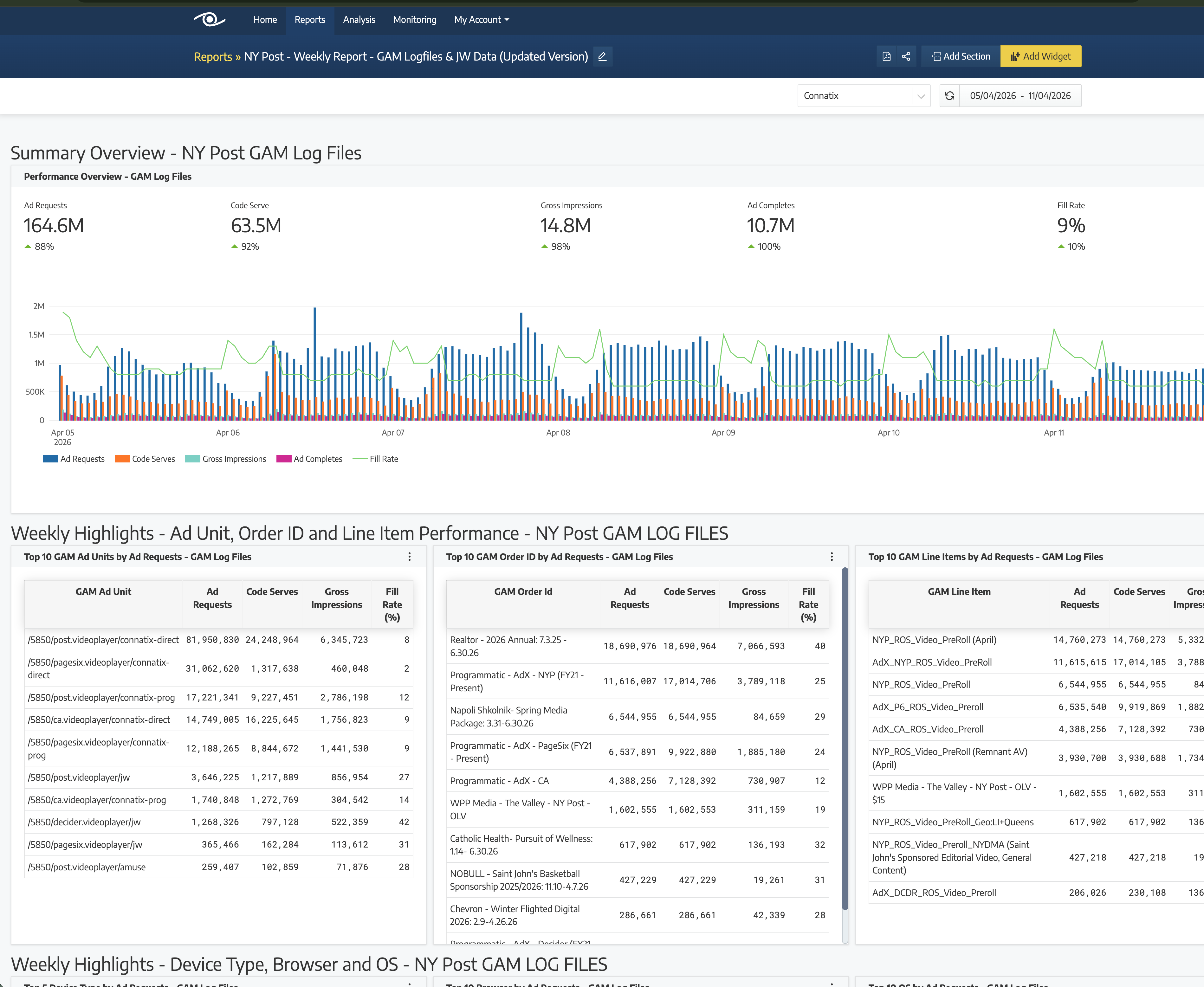
Illustrative · representative of the report-class artifact. Watching That · Reports console showing a Weekly Report (GAM Logfiles + JW Data). Five headline metric cards (requests, responses, gross impressions, ad starts, fill) plus the seven-day trend ledger. Neutral state; the surface the monthly reconciliation collapses into.
Illustrative · Weekly Report — five headline metric cards (requests, responses, gross impressions, ad starts, fill) above the seven-day daily-bars trend ledger.
ILLUSTRATIVE · WEEK-IN-REVIEW · requests · impressions · fill · one ledger, seven days, signed
What changed

Diagnostics, troubleshooting, and reporting — one live data layer.

Inspect, Analysis, and Report run against the same live data layer the Post’s revenue-operations team works in — so an issue that touches GAM, an SSP, and a partner deal surfaces as one root cause, not three escalations.

Module · Inspect

Diagnostics and troubleshooting tools, log-level.

NY Post’s revenue-operations team uses Inspect for log-level event access — the diagnostics surface for revenue-impacting issues across GAM, eight SSPs, and partner deals.

Module · Analysis

Find, fix, and solve — across the whole stack.

The Analysis module correlates the delivered-vs-expected signal across the supply chain — so an issue that touches GAM, an SSP, and a partner deal surfaces as one root cause, not three escalations.

Module · Report

Rich business-grade reporting — everyone in the know.

Reports rendered against the same live data layer the operators work in — so the CRO view and the trafficker view match, every time.

Anchor · caught anomaly

The receipt.

NY Post · 9 months · 2024
2M+
daily impressions protected across video and display supply — diagnostics, troubleshooting, and reporting on GAM and eight SSPs.
Supervising · GAM · 8 SSPs
Reference event · caught
The same platform, your stack

Walk Inspect, Analysis, and Report on your stack.