Skip to content
watchingthat
Product · Validation Monitors

Validation Monitors.

The monitoring your team meant to build. Three monitors free for life on FreeWheel or GAM.

Each monitor encodes one QA rule a trafficker used to check by hand. The rule runs every ten minutes or so against the live ad-server API — and deep-links straight back into FreeWheel or GAM the moment it fires.

Real engineer. Your stack on screen. No deck.

Read-only API connection ~10-minute cadence FreeWheel or GAM only
What a monitor catches

Four rules, written once,
watched forever.

Every monitor encodes one QA check — the kind your infrastructure monitoring (Datadog, Splunk, the rest) doesn’t see. Datadog watches your servers; VM watches whether your ad server config — including the SSP and partner-deal rules it holds — is actually doing what you sold. Here are four checks a trafficker used to do by hand — and now doesn’t.

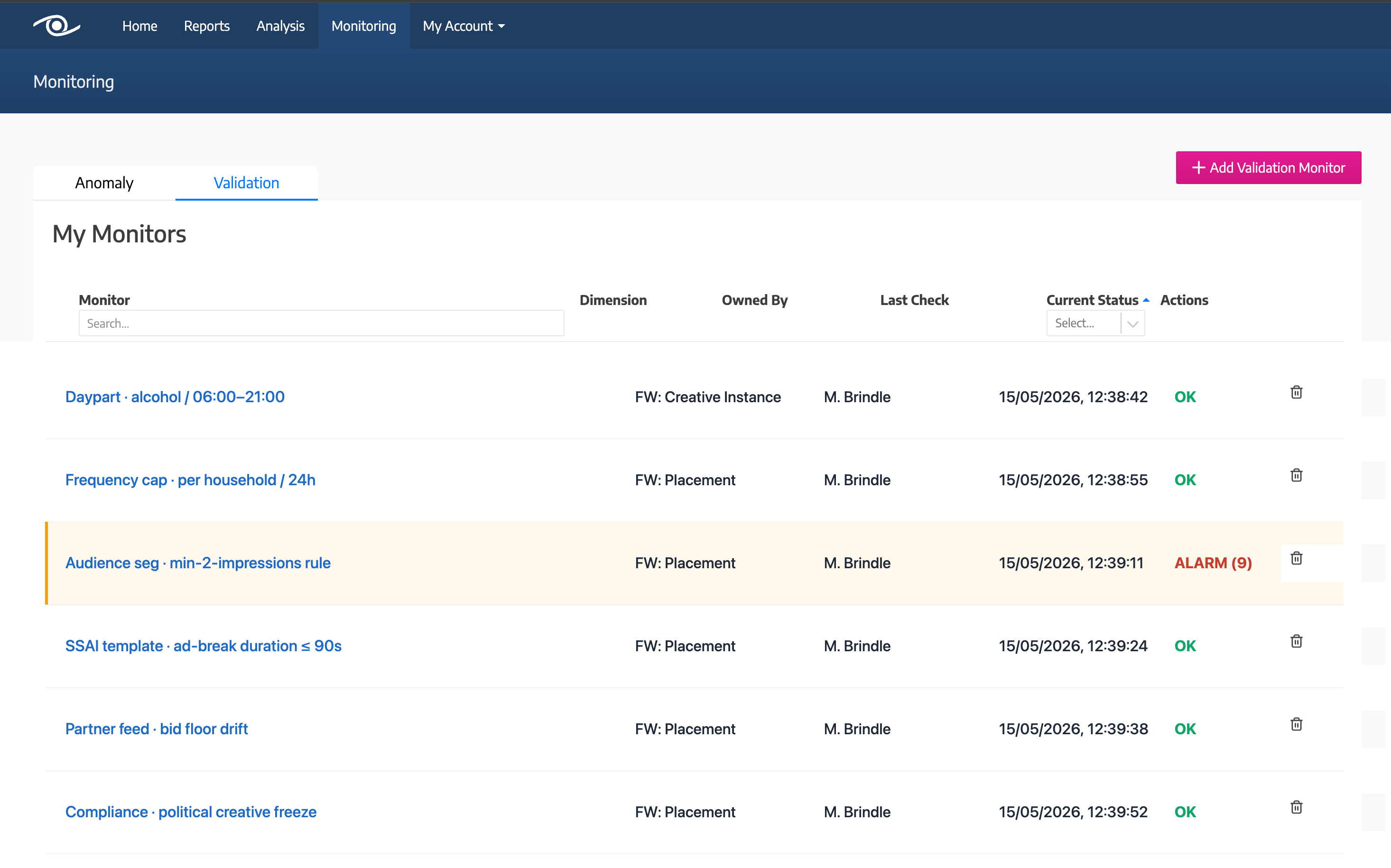
Dayparts

The alcohol spot that wants to run at 9am.

Rule written once: "alcohol creative · 06:00–21:00 · broadcast region X." If the partner template drifts, or the trafficker edits by hand, or a new creative inherits an old flight — the monitor catches it before the regulator does.

Frequency caps

The household that saw the same spot nine times.

Rule written once: "per-household frequency cap · 3 / 24h · segment Y." Caps drift through template inheritance more often than people think. The monitor reads the live config, not the dashboard summary.

Audience segments

The campaign that quietly lost its targeting.

Rule written once: "segment Z · min 2 impressions · reach threshold." When a segment gets renamed upstream and the rule resolves to empty, nothing errors — the campaign just misses. The monitor compares target to runtime, not target to target.

Partner handoffs

The bid floor that changed without a ticket.

Rule written once: "bid-floor · partner P · ≥ $X · deal tier T." When the partner-side change lands through their UI, your dashboard shows nothing. The monitor reads the bid-facing config and fires the moment the floor moves past its threshold.

What recent catches look like

Nine catches
from one monitor.

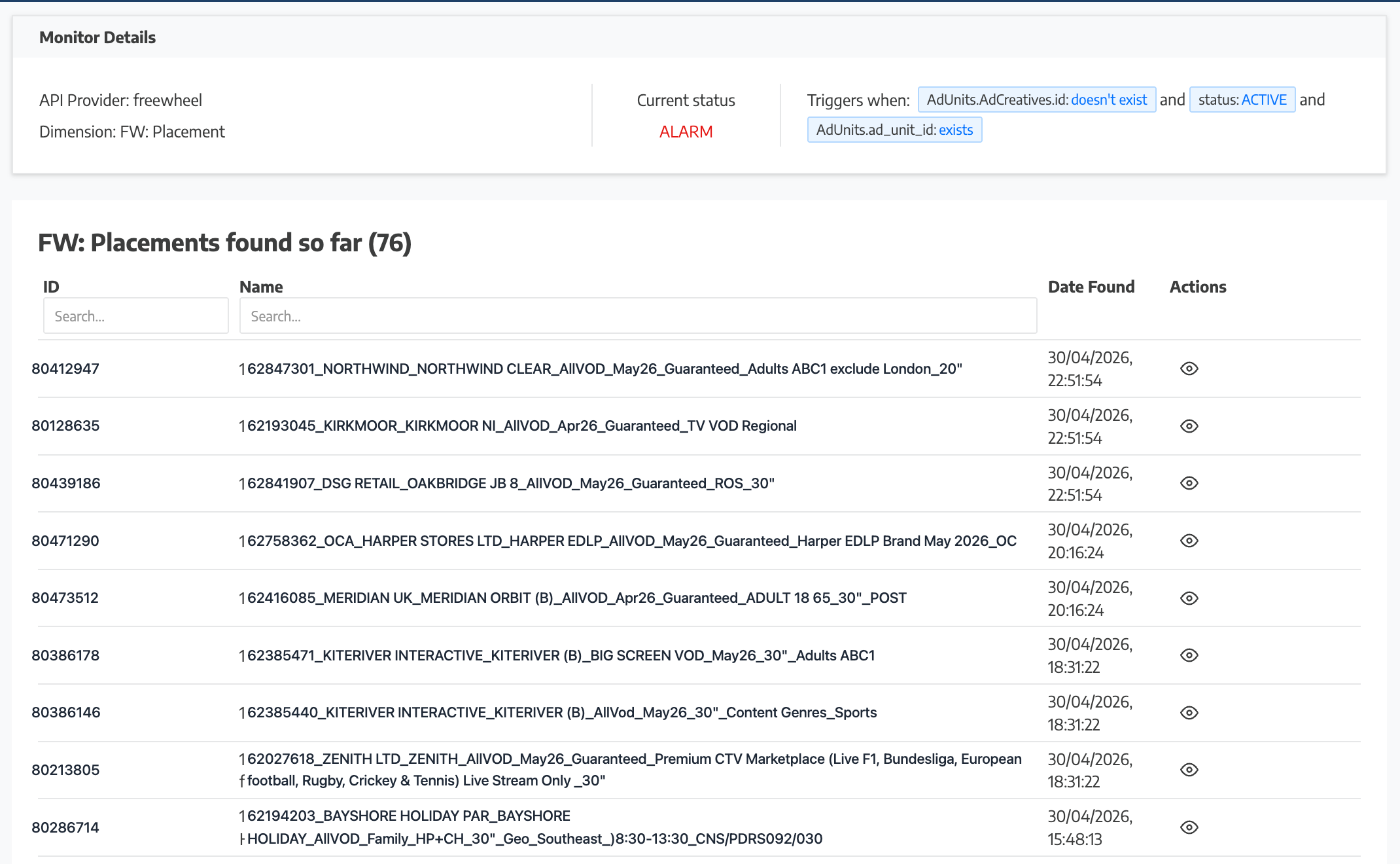
One monitor — a placement-name format check — catching nine drifts in a single day. Each row is a placement that doesn’t match the convention, with a deep link back to the line item to fix.

Recent catches in the Watching That Validation Monitors product surface — a list of placement-name drifts caught by a monitor, each row showing the placement, its name, and the date found.
Validation Monitors recent-catches surface · representative of the catch-class events observed
How VM grows

From three to eighty.

The growth is the team’s, not ours.

What a deployment typically looks like at six months: three free monitors cover the first month — usually alcohol daypart, household freq cap, one creative-compliance rule. By month three the count is often past twenty: every escalation that surprised the team is now a rule, and every rule that keeps firing has been sharpened. By month six the library can cross eighty — the same first-month seat the deployments below this section grew out of.

Maturity of a Validation Monitors deployment over six months: three monitors at month one, twenty plus by month three, eighty plus by month six.
How it connects

One connection,
read-only.

VM runs against your existing FreeWheel or GAM account. No data leaves your system. No write access. No new ad-server workflow for your team.

01
Read-only API connection

Service-account credentials to your FreeWheel Admin or GAM Network. Scoped to the endpoints VM actually reads. Revocable by you, any time.

02
~10-minute cadence

Every monitor checks its rule against the live config every ten minutes or so. Not nightly. Not quarterly. Fires as an alert by email or Slack, named with the campaign and the partner.

03
Deep links back to the source

Every fire is a link straight to the specific line item, creative, or package in FreeWheel or GAM. The trafficker clicks once and lands on the exact object to fix — not a summary, not a search.

!
FreeWheel or GAM only, today.

Validation Monitors connect to FreeWheel or GAM. SpringServe is not supported for VM. Anomaly Monitors (the sister surface) cover a wider set of ad-ops systems including SpringServe — see the Platform overview.

What does it cost?

Three monitors free for life of the account, on any FreeWheel or GAM connection. Additional monitors are tier-priced by volume — you see the tier before you commit.

No credit card No tier labels No auto-upgrade
In production

What tenants run at rest.

These aren’t pilots. These are monitor libraries in steady-state use.

Broadcaster · UK
80+ Validation Monitors in production
“On a Friday night, a monitor caught a daypart-config drift that would have run an alcohol spot against a morning audience. The regulator wasn’t the first to know.”
— Ad Operations Lead
Digital Publisher · US
24M Over-delivered impressions caught mid-flight on one title
“A 24-million over-delivery on a major title would have walked out the door as make-goods. The monitor caught the trajectory mid-flight, while there was still time to fix the pacing. Partner didn’t need to know.”
— Director, Programmatic Operations
Pay-TV scale
$50K Typical hourly exposure at Pay-TV scale · caught before reconciliation
“The monitor fires with the number attached. The escalation call starts with what we’re actually losing per hour, not with "something looks off on a dashboard."”
— Head of Ad Operations
What it's worth

What VM is worth.

Three categories of money-loss your reports don’t catch. Each one VM watches at the live config — before the loss is the loss.

Risk avoided

The call from the regulator you don’t get.

Alcohol daypart breaches. Political-creative violations. Freeze-window slips. These don’t show up as anomalies — they show up as fines that start at six figures. VM catches the config drift that creates the breach, hours before it goes live.

Revenue protected

The 3% drift that quietly burns budget.

Frequency-cap drift doesn’t error. It doesn’t alert. It just spends. A 3% over-cap on a $50M campaign is $1.5M of waste — and your reports won’t catch it until reconciliation does, six weeks later. VM watches the live config, not the dashboard summary.

Margin protected

The underdelivery you catch while the campaign still runs.

Underdelivery against a sold campaign isn’t fixable after flight — it’s a make-good, and the inventory you owe is free. VM catches the pacing trajectory mid-flight, while there’s still time to fix the cause and hit the guarantee.

Fines. Wasted budget. Make-goods. The three things your CFO asks about every quarter — VM watches them every ten minutes or so.

Connect once.
Three monitors,
free for life.

VM is a hands-on setup today. One call, one read-only credential, rules running in your first week.

Where this leads.

Most teams that start with three monitors don’t stop at three. The same data that catches drift becomes the data that explains anomalies, validates partner deliveries, and answers the questions ops directors used to chase across four dashboards. That’s the Operations Control Platform — and Validation Monitors are how teams begin operating it.