
Skip to content
watchingthat
Broadcasters & Pay TV · Operations Control Platform

Hours while you find out. The Operations Control Platform that catches it in minutes.

Operational supervision for linear, VOD, and addressable on FreeWheel — the detection gap is quantified, the catch is named, and the audit trail signs itself. Without another dashboard your team has to check.

Watching That · Monitoring console for broadcaster operations on masked tenant NORTHWIND BROADCAST. Thirteen anomaly monitors across linear, VOD, and addressable supervision; one row (Placements delivery drop on FreeWheel placement dimension) carries the anomaly orange flag at ALARM (33) state.
NEWLY FLAGGED · 09:42 Placements delivery drop · FW: Placement · ALARM (33)
Stack we cover
Linear
FreeWheel · Invidi · Publica · Harmonic
VOD & OTT
GAM · SpringServe · FreeWheel DRAX
Addressable
Invidi · Vizio · Samba · Xandr
Something missing? See the full integrations list.

Native connectors above + anything else via standard data feed.

Typical tenant · at steady state
Supervising
Monitors in production
80+  (top-tier broadcaster)
MTTD on caught events
< 15 min
Four pains

Four pains. One supervising state.

Every broadcaster ad ops team you'd benchmark against has a version of these. Naming them is the first move; closing the detection gap is the next.

01 · Detection gap

Your team has already done the math on the bleeding hour.

$50K/hour is the public number at Pay-TV scale. Your number is on a spreadsheet somewhere. MTTD is measured in hours; you need it in minutes. The platform you have produces a dashboard, not a signal.
02 · Compliance

An alcohol ad in the wrong daypart. A six-figure regulator call.

Daypart restrictions, audience filters, CPM-floor breaches. Each one is a regulator call or a revenue clawback. Your team runs spot checks. Things still slip through.

03 · One number

Ad Ops sees one. Tech Ops sees another. Yield sees a third.

The monthly meeting argues about whose data is right while the issue is still bleeding. The CRO asks. Three teams answer. Nobody has the same answer.

04 · Headcount

Set-top box. App-based VOD. Third-party distribution. FAST partners.

Every quarter adds a surface. Hiring doesn’t keep pace; complexity grows faster than headcount. The supervising state has to scale where the team can’t.

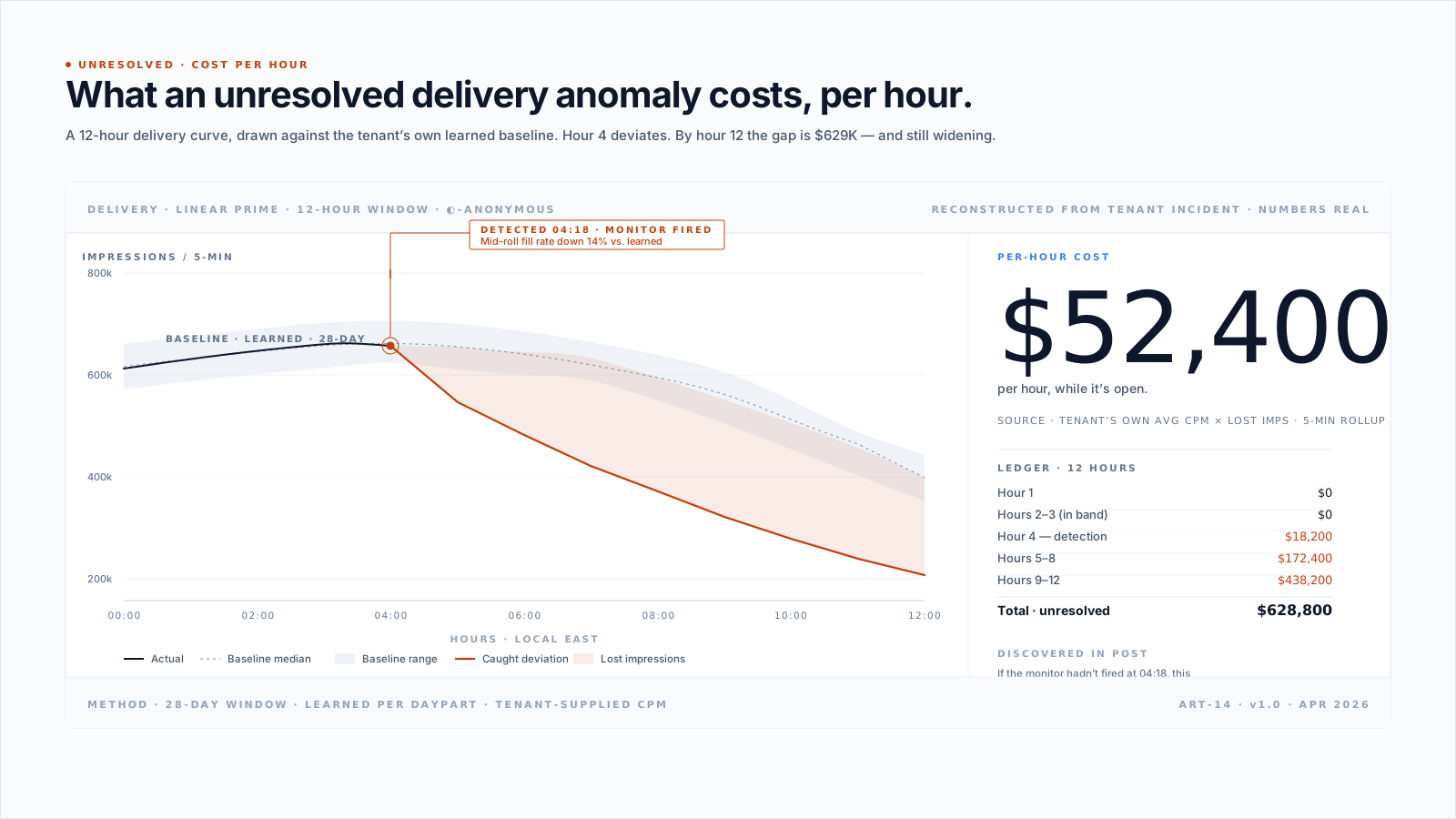
What an unresolved delivery anomaly costs, per hour — a dollar-anchored curve plotting hourly exposure against industry MTTD reference at Pay-TV scale.
How it works

One supervising state. Three layers.

Anomaly Monitors catch the fire. Validation Monitors prevent the next one. Analysis names the cause. All three feed one audit trail your CRO reads — without your team writing it.

Anomaly Monitor

Catches revenue drops at the ad-server level before the morning report lands.

Runs continuously against FreeWheel, GAM, and the addressable side. When delivered impressions deviate from the campaign’s own baseline — not an industry benchmark, your baseline — an operator gets the alert with the probable cause already named.

Walk an Anomaly Monitor · 30 min
Validation Monitors

Finds the config drift you didn’t know you had.

Three are free for life on any FreeWheel or GAM connection. Top-tier broadcasters run 80+ of them. The Friday-night alcohol-compliance catch was a Validation Monitor firing on a daypart change no-one remembered making.

Walk the VM library · 30 min
Analysis

Walks the revenue variance back to the config change that caused it.

When the quarterly review surfaces a shortfall, Analysis correlates the delivered-vs-expected variance against your config, policy, and partner changes in the same window. Six-week discovery collapses to six minutes.

Walk an Analysis query · 30 min
The screen

One monitor, caught mid-fire.

One Validation Monitor catching the daypart breach on a top-tier broadcaster’s linear stack. The alcohol spot didn’t run against the wrong audience. The configuration was reverted within nine minutes of the alert firing. The audit trail signed itself.

Caught anomaly

Broadcasters supervising at scale.

Five broadcasters running the Operations Control Platform across linear, VOD, addressable, FAST, and pay-TV.

Streamer · US
70% Error reduction across owned ad-server config
Broadcaster · UK
80+ Validation Monitors in production · 5+ years live
Multi-station broadcaster
91% Unused-inventory drift surfaced · cross-system FAST distribution
Pay TV
$50K / hr Typical hourly exposure at Pay-TV scale · caught before reconciliation
What it's worth

What broadcaster supervising is worth.

Three meters the platform moves at broadcaster scale.

Revenue protected

From hours to under 15 minutes MTTD.

You’ve done the math on the bleeding hour. The platform catches it inside the first 15 minutes — measured at the live config, not at the morning report. Every hour of compression is your team’s quarterly review going differently.

Risk avoided

The six-figure regulator call you don’t get.

Alcohol-daypart breaches, gambling protected-window slips, CPM-floor failures. None of these surface as anomalies — they surface as fines or revenue clawback. The QA layer catches the config drift before the breach is the breach. Across linear, VOD, and addressable.

Time protected

Ad Ops, Tech Ops, and Yield on one number.

The monthly meeting stops being an argument about whose dashboard is right and becomes a decision about what to do. The CRO asks; three teams answer with the same trace. The audit signs itself.

Three meters. One Operations Control Platform. The math gets attention from finance every time.

Five broadcasters. One supervising state.

The Operations Control Platform — running on FreeWheel-based broadcasters at five different shapes of scale. Thirty minutes walks you through what your shape looks like.

70%80+91%FreeWheel+$50K/hr